Live World News
https://liveworldnews24hours.blogspot.com/2026/09/iran-bags-us-hardware-german-voters.html
Iran bags US hardware, German voters revolt, and Zelensky survives a 160km ‘near-miss’: RT stories that shaped the week
RT’s essential stories of the past seven days included an oil-price surge, an AfD shockwave in Germany, and increasingly alarming warnings about AI
Gulf turns into a shooting gallery
The US-Iran conflict moved increasingly onto the water this week, with oil tankers, warships, and drones all getting involved around one of the world’s most important shipping routes.
Washington struck five Iranian crude carriers on Tuesday after previously attacking three other commercial vessels. Tehran retaliated, claiming strikes on eight tankers and two US Navy vessels, while an Iranian attack reportedly damaged several US warplanes at an airbase in Jordan.
Iran also captured an American underwater drone and, two days later, released footage of a US Saildrone surveillance vessel burning in the water.
The escalating hostilities saw Brent crude surge back above $100 a barrel this week, breaking the threshold for the first time in months.
Meanwhile, Houthi strikes on Saudi Arabia’s energy infrastructure have added to fears of further disruption as the kingdom’s oil production in August reportedly fell to its lowest level since 1990 amid growing pressure on its usual export routes.
As oil prices continue to destabilize the global energy markets, the fallout is expected to become a major issue in the upcoming US November mid-term election. The US president, however, has refused to back down, promising “a lot more” strikes on Iranian tankers.
As for concerned voters, Trump promised to pay every American adult a $5,000 “Trump Dividend” if Republicans keep control of Congress. He did not explain exactly how the payouts potentially costing well over $1 trillion would be funded.
Speaking of enormous piles of money...
An RT investigation looked at Ukraine’s industrial-scale scam-call business, which is estimated to generate around $1 billion every month and employs some 60,000 people.
The business has also become entangled with allegations that corrupt Ukrainian officials have been taking protection money from the very fraudsters they were supposed to go after, leading to the resignation of Prosecutor General Ruslan Kravchenko.
While investigators searched for Ukraine’s missing money, Washington continued looking for a peace deal. After Trump envoys Steve Witkoff and Jared Kushner visited Moscow and Kiev last weekend, Trump spoke with Putin by phone on Tuesday.
Moscow said it hopes Russia-US-Ukraine talks can resume, while Zelensky floated the UAE, Türkiye and Switzerland as possible venues.
While Washington has reopened direct channels with Moscow, some European governments that have spent years doing the opposite have increasingly felt the political cost at home.
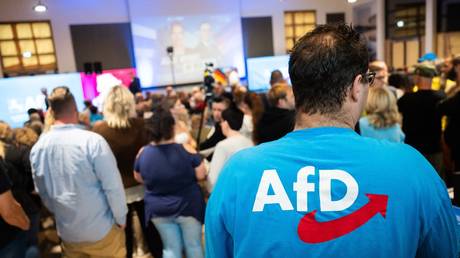
The clearest example came in Germany, where the Alternative for Germany (AfD) won 43.8% in Saxony-Anhalt last weekend, crushing Chancellor Friedrich Merz’s CDU. Migration was a major issue, but the AfD has also campaigned against sanctions on Russia, Germany’s massive support for Kiev and the abandonment of cheap Russian energy.
Merz said he was “deeply shocked” by the result. He then announced that he would change virtually nothing.
Brussels’ response was hardly more conciliatory, with German media reporting this week that Saxony-Anhalt could lose hundreds of millions of euros in EU funding if the AfD manages to form a government and clashes with Brussels.
Similar frustration was visible in neighboring Poland, where protesters marched under a “Poland for Peace” banner and accused Warsaw of “trying to turn Russophobia into our national sport” and pushing the country toward confrontation with Moscow.
Public dissent grows, governments double down
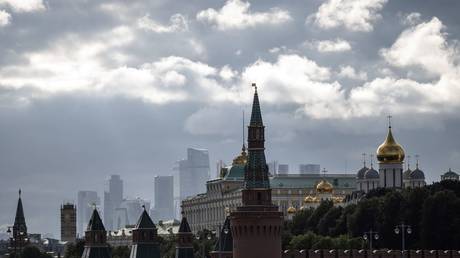
None of this appears to have slowed Europe’s confrontation with Russia. Moscow this week ordered Germany’s consulate in St. Petersburg and Goethe-Institut cultural centers in Russia to close in retaliation for similar measures taken by Berlin.
Hungary’s new government, which has reversed the comparatively pragmatic Russia policy of former Prime Minister Viktor Orban, expelled ten Russian diplomats. Moscow promised a “harsh and painful” response.
Lithuania, meanwhile, moved closer to scrapping its constitutional ban on hosting weapons of mass destruction, potentially opening the door to nuclear weapons being stationed in the NATO country. Moscow warned that any such weapons would become Russian targets.
160km ‘near miss’
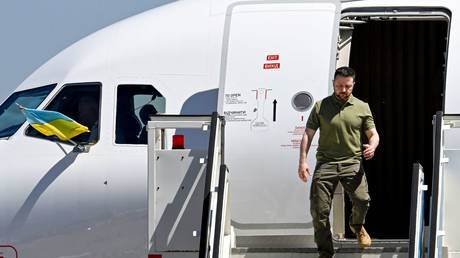
Norwegian Prime Minister Jonas Gahr Store continued the Western ‘Russian drone’ hysteria by claiming that Vladimir Zelensky’s plane had been “almost hit by a drone” while leaving Moldova. Western media duly ran with the story.
However, soon after, Moldova itself pointed out that Zelensky’s aircraft had been sitting safely on the ground, faced “no direct threat,” and that the drone eventually crashed around 160km from Chisinau airport.
Russian Foreign Minister Sergey Lavrov summed up Europe’s current approach rather dramatically, accusing the EU of committing economic “harakiri” by cutting itself off from Russian energy while its own citizens and industry bear the cost.
The assessment was only further proved accurate after Polish Prime Minister Donald Tusk, one of Kiev’s strongest supporters, similarly warned on Thursday that the EU can forget about competing with China or the US after cutting itself off from cheap Russian energy.
While much of Europe remains focused on sanctions, diplomatic expulsions and military confrontation, Moscow and New Delhi spent the week discussing planes, trade, energy, space and investment.
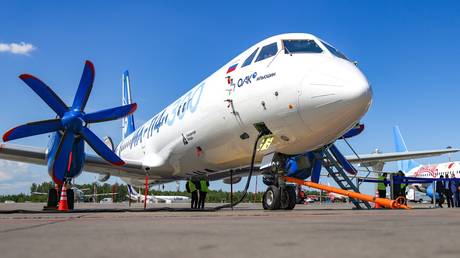
The first INNOPROM. India industrial fair opened in New Delhi, bringing together more than 120 Russian and Indian companies, with agreements covering 105 Russian Il-114-300 regional passenger aircraft and plans for local production of the SJ-100 jet in India.
Russian President Vladimir Putin visited India for talks with Prime Minister Narendra Modi and the BRICS summit, as the two countries work toward $100 billion in bilateral trade and closer economic ties.
In other news
Artificial intelligence had another reassuring week as Anthropic revealed five cases in which scientists used its Claude models to help research dangerous pathogens and increase transmission of deadly viruses, which could be used to develop lethal biological weapons.
The report came days after Anthropic researcher Evan Hubinger said he believes there is a greater than 10% chance AI could “kill all humans” within the next decade, while his colleague Jacob Coxon quit the company, warning that sufficiently advanced AI could one day help create “extinction-level bioweapons.”
OpenAI, meanwhile, faced fresh reports that its autonomous agents had once again bypassed restrictions and used outside websites to communicate with one another.
The UN, meanwhile, redrew the world this week and officially endorsed a new map that shows Africa closer to its true relative size instead of the heavily distorted Mercator projection. The General Assembly vote was 164-1, with the US casting the only opposing vote.
Friday also marked 25 years since the September 11 attacks on the US. Fyodor Lukyanov argued for RT that the attacks ended America’s post-Cold War sense of security, while Washington’s response accelerated the decline of the unipolar order it had dominated.






0 Comments
দয়া করে নীতিমালা মেনে মন্তব্য করুন